
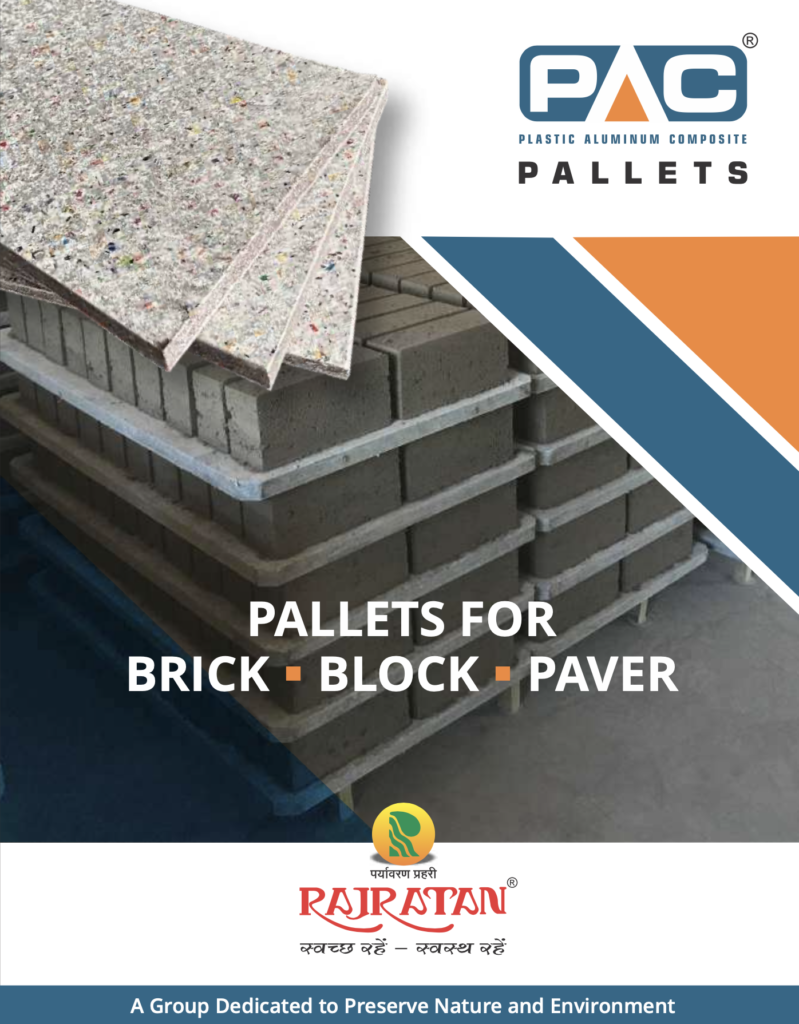
If you run a fly ash brick or block manufacturing plant in India, you know the daily struggle with plywood pallets. The heavy vibration of the block-making machine, constant water exposure, and rough handling by laborers destroy traditional plywood sheets in just a few months. They swell, warp, crack, and eventually break, halting your production and eating into your hard-earned profits.
To keep your brick plant running smoothly without frequent shutdowns, you need a pallet that can handle high pressure, water, and heavy vibration day after day.
Let us look at why traditional plywood fails and why modern composite materials are now the top choice for brick manufacturers across India.
Table of Contents
ToggleWhy Traditional Plywood Pallets Fail in Fly Ash Brick Plants
Plywood pallets fail in fly ash brick plants because wood naturally absorbs water from the wet concrete mix, which causes the internal wood layers to swell, rot, and split under heavy machine vibrations.
When you operate high-pressure hydro-vibrating machines, the pallet takes a massive beating. Here is why wooden pallets simply cannot survive this environment long-term:
- Water Absorption: Wet fly ash mixes contain high moisture. Plywood absorbs this water, leading to fungal growth, rot, and layer separation (delamination).
- Vibration Damage: The intense force of vibrating tables cracks the glue lines inside plywood, making the boards soft and weak.
- Corner Damage: Laborers drop and stack pallets quickly. Wooden corners chip off easily, making the pallet useless for automatic brick machines.
- High Lifetime Cost: Even if a plywood board is cheap to buy initially, replacing it every 6 to 12 months makes it incredibly expensive over a three-to-five-year period.
The Best Alternative: What is a PAC Plastic Pallet?
A PAC Plastic Pallet is an industrial-grade composite board made of recycled virgin plastics reinforced with aluminium oxide, cotton fibres, and cross-linked polymers (XLP) metals, specifically engineered to withstand heavy machine vibrations and wet curing conditions.
[PAC® Material Composition]
Industrial Plastics (PP, LDPE, HDPE) provides flexibility & water resistance
Aluminium Oxide adds surface hardness & wear resistance
Cotton Fibres increases tensile strength & prevents cracking
└ XLP Metals provides structural stiffness
This unique material blend is called Plastic Aluminium Composite (PAC®). Developed by Rajratan Industries Private Limited in Indore, this patented material does not absorb a single drop of water. It is completely immune to chemical reactions from cement, fly ash, or curing additives. Unlike a standard HDPE brick pallet or a cheap PVC plastic pallet that can become brittle in extreme Indian summers, the Rajratan PAC pallet remains stable and flat from 0°C to 55°C.
PAC vs. PVC vs. Plywood Pallets: A Direct Comparison
To help you make the right choice for your factory, here is a direct comparison of the most common pallets used in the Indian brick industry:
|
Feature / Specification |
Traditional Wooden Plywood |
Standard PVC Brick Pallet |
Rajratan PAC Plastic Pallet |
|---|---|---|---|
|
Water Absorption |
Very High (Swells & warps) |
Zero |
Zero (100% Waterproof) |
|
Average Lifespan |
6 to 12 Months |
2 to 3 Years (Becomes brittle) |
3 to 10 Years (Based on grade) |
|
Vibration Resistance |
Poor (Layers split apart) |
Moderate (Can crack at corners) |
Excellent (Absorbs shock easily) |
|
Weight of 18mm Board |
Light (~25-28 kg) |
Heavy (~45-50 kg) |
Balanced (~38-42 kg) |
|
Resale / Scrap Value |
Zero (Trash value) |
Very Low |
40% Buyback Guarantee |
|
Impact of Sun/UV |
Cracks and warps |
Fades and cracks |
100% UV Resistant |
Rajratan PAC Brick Pallet Grades and Specifications
Different block-making machines require different pallet strengths. A small vibrating table needs a different board stiffness than a fully automatic, imported 12-block hydraulic machine. Rajratan manufactures PAC pallets in three distinct industrial grades to match your specific machinery setup:
1. Fibre Reinforced Board (Fibre Grade)
- Composition: 65% Mix Plastic (Industrial Grade), 20% Aluminium Oxide, and 15% Cotton Fibre.
- Density: 1.08 g/cm³.
- Service Life: 3 to 4 years.
- Standard Thickness: 12mm, 18mm, and 21mm.
- Best For: Top Press Hydro Machines and manual Vibrating Table Systems. This grade is highly popular for making fly ash bricks, reflective parking tiles, and standard paving blocks.
2. Metal Reinforced Board
- Composition: 62% Mix Plastic, 23% Aluminium Oxide, and 15% XLP Metals.
- Density: 1.13 g/cm³.
- Service Life: 5 to 6 years.
- Standard Thickness: 18mm, 21mm, and 25mm.
- Best For: Imported Vibro Machines and heavy-duty Hydro Vibro systems. It offers excellent stiffness, ensuring your hollow blocks and lightweight blocks maintain a perfect, uniform height during high-vibration casting.
3. Steel Reinforced Board
- Composition: 62% Mix Plastic, 23% Aluminium Oxide, 15% XLP Metals, reinforced internally with a heavy 12mm diameter Steel Tube Frame (2.5mm to 3mm wall thickness).
- Density: 1.13 g/cm³.
- Service Life: 7 to 8 years (easily stretches up to 10 years with proper handling).
- Standard Thickness: 25mm and 30mm.
- Best For: High-capacity, multi-product automatic Vibro machines. This is the ultimate composite brick pallet for heavy-duty operations, including solid concrete blocks, heavy interlocking pavers, and large-size retaining wall blocks.
Why Brick Manufacturers are Switching to Rajratan PAC Pallets
The 40% Buyback Replacement Guarantee
This is our most popular feature. When your PAC brick pallet eventually reaches the end of its long service life, you do not have to throw it away or sell it as cheap trash. Rajratan buys back your old, worn-out PAC pallets at 40% of their scrap value against your new pallet purchase. This circular economy model turns your pallet expense into a long-term business asset.
No Warping, No Swelling
Because our plastic composite pallet has zero water absorption, it stays perfectly flat. When your pallets remain flat, your bricks come out with a uniform thickness. This eliminates customer complaints about uneven brick sizes and reduces product rejection rates on your site.
High Impact and Vibration Absorption
The combination of cotton fibres and cross-linked polymers gives our pallets a natural elasticity. They absorb the heavy shockwaves of hydraulic block machines without cracking, unlike stiff PVC brick pallets which often snap under extreme, concentrated pressure.
Real-World Economics: Plywood vs. PAC Pallets
Let us look at the actual math. Many factory owners buy plywood because of the lower initial cost. But let us compare the actual cost over a 3-year operating period for a medium-scale fly ash brick plant using 1,000 pallets:
[3-Year Cost Comparison for 1,000 Pallets]
Traditional Wooden Plywood:
Year 1: Buy 1,000 Plywood Pallets ──────> ₹5,00,000
Year 2: Replacement (100% damaged) ────> ₹5,00,000
Year 3: Replacement (100% damaged) ────> ₹5,00,000
TOTAL INVESTMENT: ₹15,00,000 (Scrap Value: ₹0)
Rajratan PAC Plastic Pallets:
Year 1: Buy 1,000 PAC Pallets ──────────> ₹10,00,000
Year 2: Same Pallets (0% damaged) ──────> ₹0
Year 3: Same Pallets (0% damaged) ──────> ₹0
Minus 40% Buyback Value ────────────────> -₹4,00,000 (Asset value retained)
ACTUAL NET COST: ₹6,00,000
By choosing the Rajratan PAC pallet, you save ₹9,00,000 over three years. Plus, you save hours of downtime caused by broken wooden boards jamming your automatic conveyor lines.
(Note: If you also handle concrete formwork on your construction projects, you can explore our high-durability concrete formwork sheets at shutteringboard.rajratan.in to replace traditional plywood on-site).
How to Order, Payment Terms, and Logistics
We keep our business terms simple, transparent, and direct. We manufacture our pallets to order at our Indore factory to match your machine’s exact size requirements.
- Trial Order Policy: We highly recommend starting with a trial order of 5 to 10 sheets. This allows you to test the pallets on your actual machine, check the vibration performance, and see how easily the finished bricks slide off the smooth PAC surface
- .
- Payment Terms: Our standard payment terms are 30% advance payment to lock in the order and start production, and the remaining 70% balance payment before dispatch from our factory. We do not offer Cash on Delivery (COD) because we ship through external commercial transport companies.
- Logistics & Delivery: We ship materials all over India using reliable transport networks like VRL Logistics, BRL Logistics, TCI Freight, and ACPL. Shipping charges are paid directly to the transporter. Small trial orders are sent on a “godown delivery” basis (you pick them up from your nearest transport warehouse), while full truckloads are delivered directly to your factory gate.
- Dealership Queries: If you want to become an authorized dealer, we require an in-person visit to our Indore office and factory for a face-to-face meeting with our management team. The minimum order to qualify for a dealership is a full truckload (approx. 600 sheets).
Frequently Asked Questions (FAQs)
Q1: Can we use nails or screws on Rajratan PAC pallets?
Yes, you can easily nail, screw, saw, and drill Rajratan PAC pallets using standard carpentry tools. The dense composite material holds nails and screws much more tightly than hollow PVC boards, and the holes do not expand or weaken when exposed to water.
Q2: How does the 40% buyback guarantee work practically?
The 40% buyback guarantee works by allowing you to return your old, broken, or worn-out Rajratan PAC pallets to our Indore factory, where we calculate 40% of their original purchase value and deduct that amount from your bill for a fresh batch of new pallets.
Q3: Why is a PAC plastic pallet better than a cheap PVC plastic pallet?
A PAC plastic pallet is better than a cheap PVC pallet because the added aluminium oxide and cotton fibres prevent the board from bending under heavy loads or cracking during cold winters and hot summers. PVC pallets often become brittle and snap when exposed to constant sunlight and heavy vibrating forces.
Q4: How many days does it take to deliver the pallets to my site?
Standard delivery takes 2 days for states neighboring Madhya Pradesh, and 4 to 5 days for the rest of India after the order is manufactured and dispatched from our Indore plant. We will share the transport tracking receipt immediately upon dispatch so you can track your shipment.