
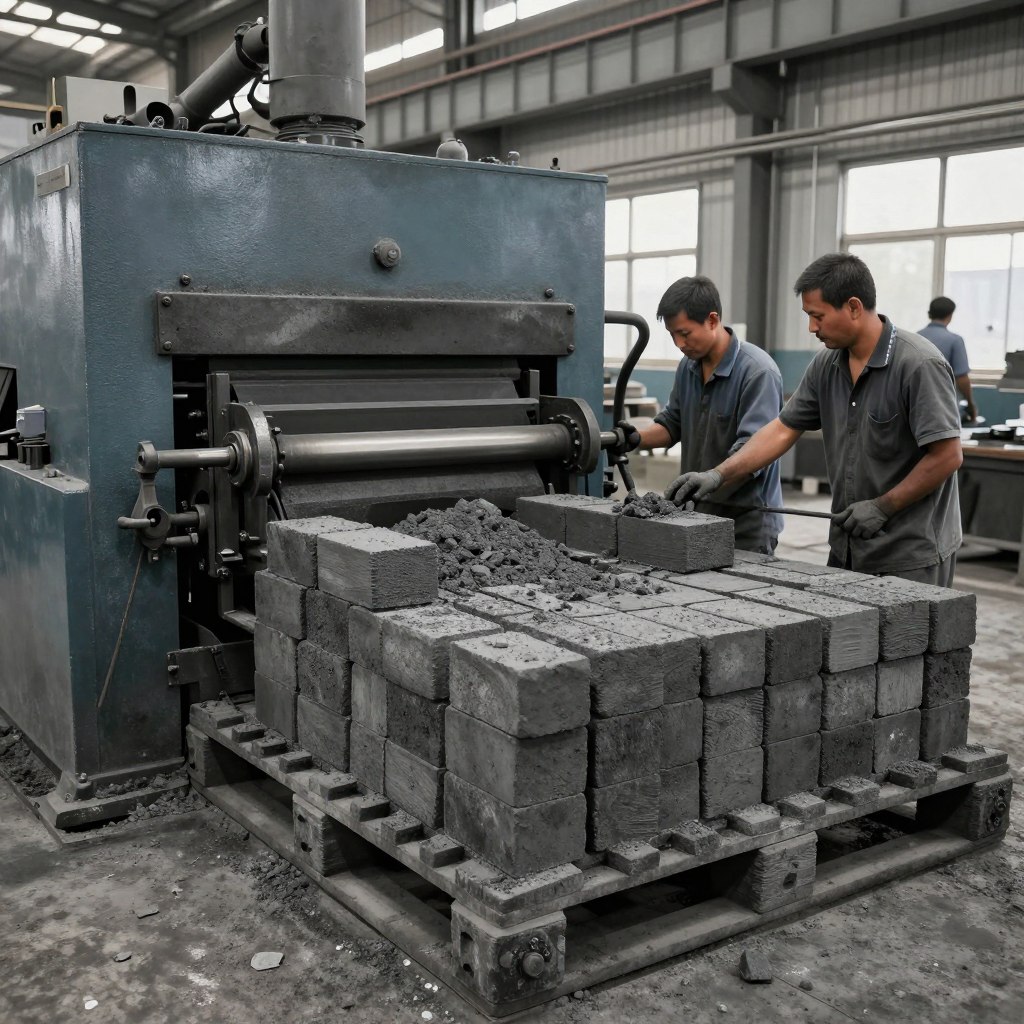
India produces over 200 million fly-ash bricks annually, making it one of the world’s largest manufacturers of this sustainable building material. Fly-ash brick production combines industrial precision, material engineering, and innovative equipment design to deliver cost-effective, durable construction units at scale.
Table of Contents
ToggleThe Fly-Ash Brick Manufacturing Process: Step-by-Step Guide
Modern fly-ash brick production follows a systematic, automated workflow designed to maximize output quality while minimizing defects. Here’s how industry leaders execute each critical stage:
| Process Stage | Raw Mix Ratios | Compaction Pressure | Curing Time | Output Quality |
|---|---|---|---|---|
| Raw Material Blending | Fly Ash 50-60%, Cement 8-10%, Lime 3-5%, Sand 25-30%, Water 8-10% | N/A (Dry Mix) | 15-20 minutes | Uniform particle distribution; moisture content 8-10% |
| Compaction & Molding | Final wet mix at optimal moisture | 80-120 PSI (5.5-8.3 bar) | 2-4 seconds per brick | Dense, crack-free units; compression strength 3.5-5 N/mm² |
| Steam Curing (Autoclave) | N/A (Heat treatment) | N/A | 8-12 hours at 180-190°C | Accelerated hydration; strength reaches 8-12 N/mm² (final) |
| Air Drying & Stacking | N/A | N/A | 24-48 hours ambient | Residual moisture <12%; ready for transport |
| Quality Inspection & Sorting | N/A | N/A | Simultaneous with drying | Grade A (90-95%), Grade B (5-10%); rejects <1% |
Raw Material Sourcing & Pre-Processing
Fly Ash Procurement: Sourced from thermal power plants (TPPs), fly ash is the residual particulate matter from coal combustion. Quality varies by coal source; premium suppliers source from TPPs with consistent fuel quality to ensure uniform pozzolanic activity. Indian Standard IS 3812 (Part 1) specifies minimum fly-ash fineness of 300 m²/kg and loss on ignition <5%.
Admixtures & Binding Agents: Ordinary Portland Cement (OPC) grades 43 or 53 provide primary binding strength. Hydrated lime (Ca(OH)₂) facilitates silica-alumina reaction with fly ash. Fine sand (0.3-0.6 mm) provides workability and bulk. Additives such as plastic fibers or accelerators may be introduced to enhance durability.
Compaction Pressure & Machine Efficiency
Industrial vibro-compaction machines apply 60-120 cycles per minute at pressures ranging from 5.5 to 8.3 bar. Each compression cycle forces air out of the wet mix and densifies the brick structure, reducing porosity. Higher compaction pressure (8+ bar) yields bricks with superior water resistance and compressive strength (8-12 N/mm²), but requires precision pallets to prevent equipment wear and product damage.
Why Pallet Quality Directly Impacts Per-Unit Brick Cost
Manufacturing economics hinge on pallet durability. A low-cost pallet may crack after 40-60 vibration cycles, forcing replacement every 2-3 months. A high-durability pallet withstands 60+ cycles with zero warping or water absorption, extending service life to 7-8 years. Here’s the financial impact:
Scenario: 5,000 bricks per day production facility
- Wooden Pallets: Warping after 50 cycles. Replacement cost ₹500 per pallet × 100 pallets needed = ₹50,000 per 3-month cycle. Annual pallet spend: ₹200,000+. Cost per brick: ₹0.40/brick.
- PVC Pallets: Brittleness under sustained vibration causes cracking by cycle 30-40. Replacement: ₹800/pallet × 100 pallets = ₹80,000 per 2-month cycle. Annual cost: ₹480,000+. Cost per brick: ₹0.96/brick.
- PAC® Reinforced Composite Pallets (Rajratan): Zero water absorption. 60+ vibration cycles guaranteed. 1130 kg/m³ density with metal-dust reinforcement prevents warping. Service life 7-8 years. Investment: ₹1,200/pallet × 100 pallets = ₹120,000 one-time. Replacement cycle: 7-8 years. Cost per brick: ₹0.024/brick (97.5% cost reduction vs. wood).
PAC® Pallets: Superior Material Science for Fly-Ash Brick Production
PAC® Pallets are engineered from 100% recycled industrial packaging waste (sourced from Patanjali, Nestlé, and equivalent tier-1 facilities), reinforced with XLP polymers, aluminum oxide powder, and metal dust. Technical specifications:
- Density: 1130-1150 kg/m³ (vs. plywood 700-800 kg/m³; PVC 1200+ kg/m³ with brittleness)
- Water Absorption: 0% (zero swelling; maintains dimensional stability across 60+ cycles)
- Compressive Strength: 22.0 N/mm² (tested per IS 1734 Part 1-1983)
- Vibration Cycle Endurance: 60+ cycles without deformation or surface degradation
- Heat Resistance: Maintains integrity under autoclave steam (180-190°C for 8-12 hours)
- Surface Finish: Mirror-polished top eliminates micro-voids; zero brick surface defects
- Scrap Value Retention: After 7-8 years, retain 40% of original material value for credit against new pallet purchases
Cost-Per-Brick Calculator: The Pallet Durability Advantage
Assumptions: 5,000 bricks/day facility. Operating 300 days/year = 1.5M bricks/year. Facility operates 7 hours/day on a single shift with two 3.5-hour production windows. Standard vibro machine footprint requires 100-120 pallets in active rotation.
Calculation Matrix:
| Pallet Type | Initial Unit Cost (₹) | Pallets Needed | Total Investment | Service Life (years) | Annual Replacement Cost | Cost Per 1M Bricks |
|---|---|---|---|---|---|---|
| Wooden (35kg) | 500 | 100 | 50,000 | 0.25 | 200,000 | 133.33 |
| PVC (40kg) | 800 | 100 | 80,000 | 0.33 | 240,000 | 160.00 |
| PAC® (42kg) | 1,200 | 100 | 120,000 | 7.5 | 16,000 | 10.67 |
Result: PAC® Pallets reduce total pallet cost by 92% per brick produced, directly improving bottom-line manufacturing margin.
Curing & Quality Control: Achieving Structural Standards
Autoclave Steam Curing: Bricks are stacked in high-pressure steam chambers at 8 bar pressure and 180-190°C for 8-12 hours. This accelerates the hydration reaction between fly ash and cement, achieving final compressive strength of 8-12 N/mm² (vs. 3.5-5 N/mm² after 28 days of air curing). Strength gain is nonlinear; 95% of target strength is achieved within 6-8 hours.
Quality Assurance Testing: Every batch undergoes in-house compression testing, water absorption measurement, and dimensional verification. Laboratory-grade testing per IS 12894:2002 (Specification for fly ash bricks) ensures:
- Compressive strength ≥3.5 N/mm² for Grade A bricks
- Water absorption ≤20% (by mass)
- Efflorescence classification ≤5% (to prevent surface salt crusting)
- Dimensional tolerance ±2 mm on length and width
Industry Output & Capacity Planning
A standard fly-ash brick plant with automated molding (semi-dry process) and autoclave capacity produces 5,000-10,000 bricks per day. With 2-3 shifts and dual autoclave chambers, production scales to 20,000-30,000 bricks/day. Annual capacity for a mid-scale facility: 4.5M-9M bricks.
Pallet fleet sizing directly scales with production. A 5,000 brick/day facility requires 100-120 pallets to maintain continuous rotation (one pallet cycle = 4-6 hours from stripping to return to molding).
Free Resource: Fly-Ash Brick Margin Calculator
Download our comprehensive ‘Fly Ash Brick Margin Calculator’ — a ready-to-use Excel worksheet that auto-calculates your per-brick pallet cost, annual replacement budgets, and ROI on upgrading from wood/PVC to PAC® pallets. Includes scenario modeling for 2,500 to 50,000 brick/day facilities.
Calculator includes:
- Real production schedules (batches, shift models, downtime factors)
- Multi-pallet cost comparison (wood, PVC, PAC® with buyback credit)
- 7-year total cost of ownership (TCO) analysis
- Break-even timeline for PAC® investment
- Margin improvement projections by facility size
Get Your Free Fly-Ash Brick Margin Calculator Now →
Next Steps: Request a PAC® Pallet Sample for Your Facility
Don’t guess on pallet durability. See firsthand how PAC® Pallets perform under your facility’s exact compaction pressure, curing cycle, and product mix. We’ll send a sample pallet, technical datasheet, and reference introductions to 3-5 fly-ash brick plants running your same production volume.
Ready to reduce pallet cost by 90%+ and eliminate monthly replacement cycles?
📱 Request PAC® Pallet Sample via WhatsApp
Or fill out the form below:
Quick Sample Request:
- 📍 Facility Location: [Indore, Madhya Pradesh]
- 📊 Daily Production Capacity: [Number of bricks/day]
- 📧 Email: [info@rajratan.in]
- 📞 Phone: [+91 9685927927]
- ❓ Current Pallet Type: [Wood / PVC / Other]
We’ll respond within 24 hours with sample shipping details, technical specs, and a customized ROI projection for your facility.