
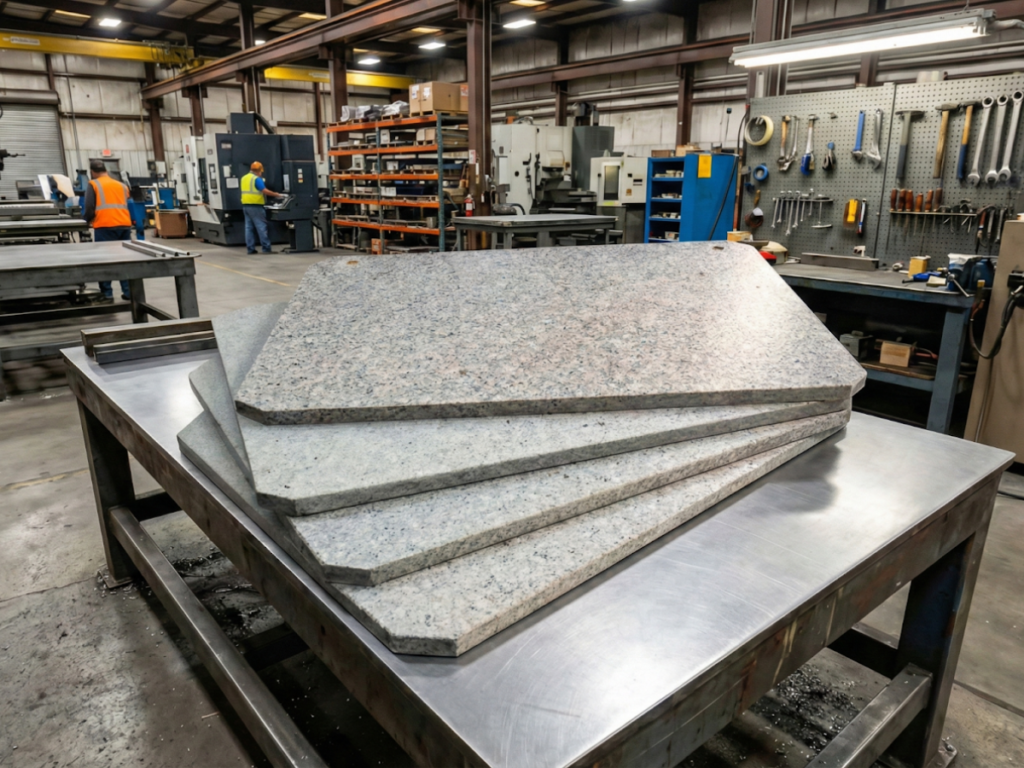
In paver and block manufacturing, quality control does not end when the product leaves the mould. In fact, some of the most critical quality losses occur after demoulding, during stacking, curing and handling.
At this stage, the paver board becomes the foundation supporting the product through its most fragile phase. And the quality of that board directly determines whether pavers cure evenly, retain sharp edges, and reach dispatch without damage.
This is where PAC® Paver Boards play a decisive role.
Surface Finish: Damage Happens After Demoulding
Many manufacturers assume surface defects originate in the mould. In practice, a large number appear later—during stacking and curing.
Low-quality paver boards can have:
- Uneven or warped surfaces
- Scratches and abrasions from repeated use
- Water-absorbing layers that stay damp
Dimensionally stable boards keep pavers level throughout curing, protecting edges and maintaining uniform thickness across batches.
A PAC® Paver Board is engineered to act as a stable curing platform, distributing load evenly across the entire surface. Unlike low-grade boards that flex or absorb moisture, PAC® boards remain flat and dimensionally stable throughout the curing cycle.
This stability prevents uneven stress on the bottom layer of pavers—one of the most common causes of cracks, edge damage and thickness variation.
Dimensional Accuracy and Edge Protection
Edge chipping and corner damage rarely happen inside the machine. They occur during stacking and de-stacking—when boards fail to provide even support.
PAC® Paver Boards are manufactured using industrial-grade pre-consumer plastics, combined with Aluminium Oxide and reinforcement materials. This formulation prevents:
- Board sagging under stacked loads
- Swelling during monsoon conditions
- Long-term deformation from heat exposure
By maintaining flatness over thousands of cycles, PAC® boards help preserve paver geometry and edge integrity—two key parameters for customer acceptance and site performance.
Rejection Rates: The Hidden Cost of Poor Boards
Low-quality paver boards degrade gradually. As they lose stiffness and flatness, plants begin to see:
- Increasing breakage during handling
- Unstable stacks
- Higher manual intervention
PAC® Paver Boards are designed for long service life, often exceeding 10 years in active use. Their consistency over time allows manufacturers to maintain predictable rejection rates instead of managing rising losses.
Built for Indian Operating Conditions
Outdoor curing yards, high temperatures and seasonal humidity place extreme demands on paver boards.
PAC® Paver Boards are:
- Fully waterproof
- UV resistant
- Heat stable
- Immune to swelling and delamination
This makes them suitable for continuous outdoor use without compromising performance. PAC® Paver board are build for every indian weather and are delivered PAN INDIA .
More Than a Board: A Long-Term System
PAC® boards are not treated as disposable items. At the end of their service life, they are supported by a 40% buyback replacement programme, reinforcing a circular manufacturing model and reducing long-term material waste.
Conclusion
In modern paver production, board quality directly affects surface finish, dimensional accuracy and rejection rates—long after the moulding stage is complete.
PAC® Paver Boards are engineered specifically for stacking and curing environments, offering the flatness, durability and consistency required to protect product quality at scale. For manufacturers aiming to reduce waste, improve repeatability and operate reliably year after year, the board beneath the paver matters more than ever.
Know more about PAC® Paver Board- Rajratan PAC® Pallet
- Phone: 0731 4045302
- Mobile: +91 96857 27927
- Email: info@rajratan.in