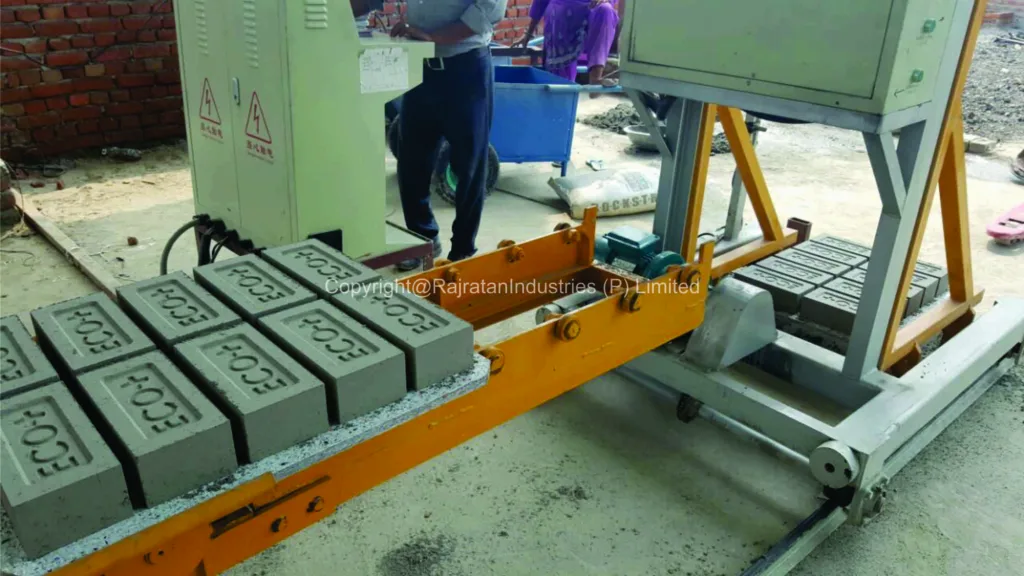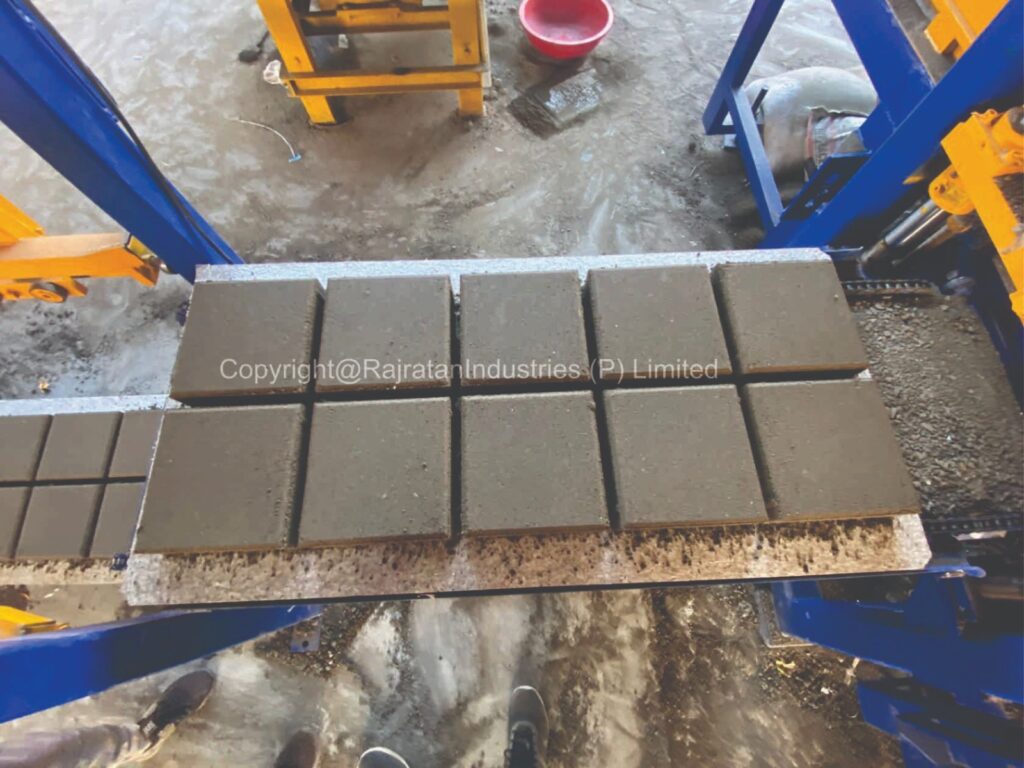
Monsoon conditions can create additional challenges for brick and concrete block manufacturers. Continuous moisture exposure, wet production areas, and outdoor storage can affect the condition of traditional wooden pallets, increasing maintenance requirements and replacement costs.
For manufacturers operating fly ash brick plants, paver block units, and concrete block factories, choosing the right pallet material is important for maintaining production efficiency.
Traditional plywood pallets can absorb moisture, swell, and develop surface damage after repeated exposure to water. Over time, these problems can affect pallet handling, machine feeding, and the consistency of manufactured products.
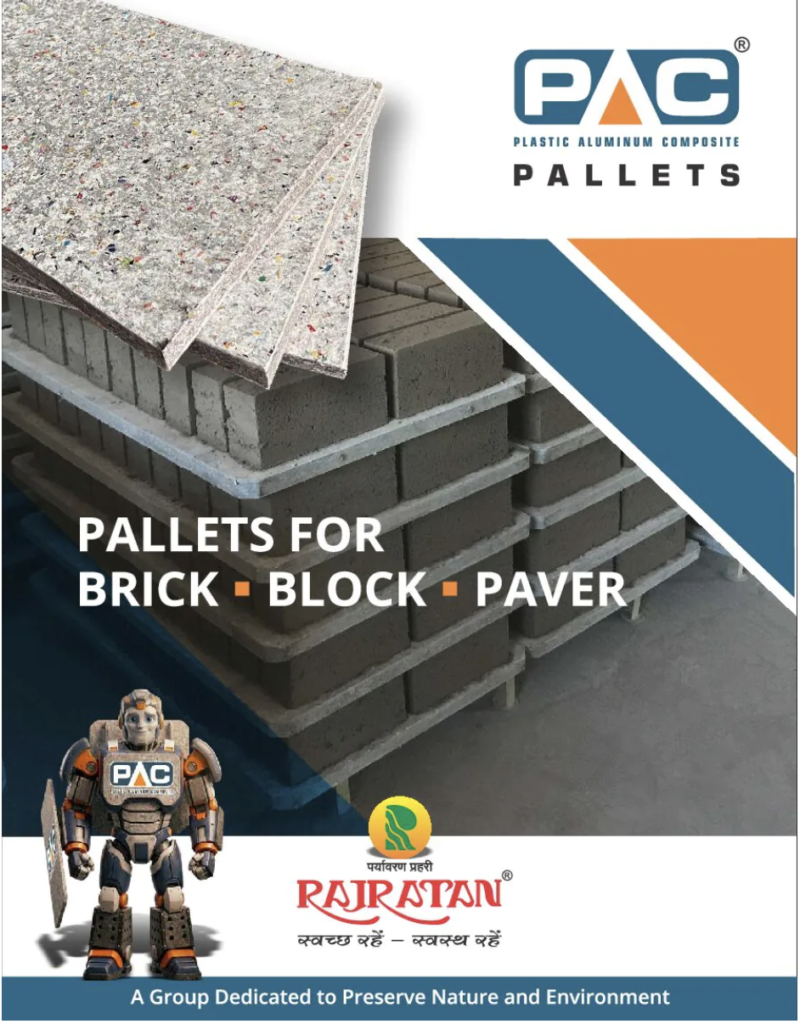
To address these challenges, manufacturers are exploring PAC® (Plastic Aluminium Composite) Pallets by Rajratan Industries.
Manufactured using industrial polymers and reinforcement components, PAC® pallets are designed to resist moisture-related deterioration and support repeated use in suitable brick and block manufacturing applications.
In this guide, we explain why waterproof composite pallets are worth considering for monsoon conditions, how their different grades compare, and what manufacturers should check before purchasing.
Table of Contents
ToggleThe Problem with Plywood Pallets During Monsoon
Water exposure is one of the major challenges associated with wood-based pallets.
In brick manufacturing units, pallets regularly come into contact with wet concrete, water, and curing environments. During the monsoon, outdoor storage can increase their exposure to moisture.
This can create several problems.
1. Swelling and Surface Damage
Plywood can absorb moisture through its surface and edges. Repeated exposure may cause swelling, delamination, and deterioration.
2. Warping and Loss of Flatness
When a pallet loses its original shape, it can create difficulties during machine feeding, handling, and product transportation.
3. Frequent Replacement
Damaged pallets need to be repaired or replaced, increasing material expenses and affecting production planning.
4. Inconsistent Production
Pallet condition is one of the factors that can influence the consistency of brick and block manufacturing. Damaged or uneven pallets may create handling and production difficulties.
These challenges make moisture resistance an important factor when selecting pallets for Indian brick manufacturing plants.
What Makes PAC® Composite Pallets Different?
PAC® stands for Plastic Aluminium Composite. These pallets are manufactured using industrial polymers such as PP, LDPE, and HDPE, along with aluminium oxide and reinforcing components.
Unlike traditional wood-based pallets, their composite construction is designed to resist moisture absorption and reduce problems associated with swelling and rotting.
Key Characteristics of PAC® Pallets
- Moisture resistance: Designed for use in environments involving repeated water exposure.
- Composite construction: Combines industrial polymers with reinforcement materials.
- Multiple thickness options: Available in different thicknesses for different production requirements.
- Reinforcement choices: Fibre, metal, and steel-reinforced grades.
- Reusable design: Developed for repeated use in suitable manufacturing applications.
- Easier cleaning: The composite surface supports routine cleaning after production.
Rajratan PAC® Pallet Grades and Technical Specifications
Rajratan offers three major PAC® pallet grades to suit different machine configurations and manufacturing requirements.
Specification | Fibre Reinforced | Metal Reinforced | Steel Reinforced |
Material composition | 65% plastic, 20% aluminium oxide, 15% cotton fibre | 62% plastic, 23% aluminium oxide, 15% XLP metals | Composite board with internal steel tube frame |
Density | 1.08 g/cm³ | 1.13 g/cm³ | 1.13 g/cm³ |
Thickness options | 12, 18, 21 mm | 18, 21, 25 mm | 25, 30 mm |
Indicative service life | 3–4 years | 5–6 years | 7–10 years |
Typical applications | Suitable vibrating-table and top-press systems | Selected hydro-vibro and imported vibro machines | Selected heavy-duty multi-product machines |
Service-life figures are indicative and depend on machine compatibility, production conditions, handling, storage, and maintenance.
1. Fibre Reinforced PAC® Pallets
The Fibre Reinforced Grade is designed for suitable vibrating-table and top-press production setups.
Its composition includes industrial plastics, aluminium oxide, and cotton fibre reinforcement.
Specifications:
- Thickness: 12 mm, 18 mm, and 21 mm.
- Density: 1.08 g/cm³.
- Composition: 65% industrial plastic, 20% aluminium oxide, and 15% cotton fibre.
- Indicative service life: 3–4 years.
2. Metal Reinforced PAC® Pallets
The Metal Reinforced Grade incorporates XLP metals into the composite structure.
It is designed for selected manufacturing applications where a reinforced pallet option is required.
Specifications:
- Thickness: 18 mm, 21 mm, and 25 mm.
- Density: 1.13 g/cm³.
- Composition: 62% industrial plastic, 23% aluminium oxide, and 15% XLP metals.
- Indicative service life: 5–6 years.
3. Steel Reinforced PAC® Pallets
The Steel Reinforced Grade combines a PAC® composite board with an internal steel tube frame.
This option is designed for selected heavy-duty applications requiring additional structural reinforcement.
Specifications:
- Thickness: 25 mm and 30 mm.
- Density: 1.13 g/cm³.
- Reinforcement: Internal 12 mm steel tube frame.
- Indicative service life: 7–10 years.
The appropriate grade should be selected according to machine specifications, pallet dimensions, and production requirements.
Why Manufacturers Are Considering Anti-Crack and Anti-Warp Brick Pallets
An anti-crack brick pallet should be evaluated on its ability to handle repeated production operations without developing premature damage.
Similarly, an anti-warp brick pallet should maintain suitable dimensional stability during handling, moisture exposure, and storage.
PAC® composite pallets are designed to address common problems associated with conventional wooden pallets.
1. Resistance to Moisture-Related Deterioration
The polymer-based composite structure is designed to resist moisture absorption, helping reduce the swelling and rotting problems commonly associated with plywood.
2. Reinforcement Options
Different reinforcement grades are available for different production requirements. Manufacturers can explore fibre, metal, or steel-reinforced options according to their machinery.
3. Repeated Production Use
The different PAC® grades offer varying indicative service-life ranges, allowing manufacturers to compare options according to their production requirements and operating conditions.
4. Easier Routine Maintenance
The composite surface can make cleaning easier after production. Routine inspection and proper storage remain important for maintaining pallet condition.
Cost Analysis: Why Look Beyond the Initial Pallet Price?
A lower purchase price does not always mean a lower long-term operating cost.
For brick and block manufacturers, frequent pallet replacement can increase material expenses and create additional work for production teams.
When comparing plywood and PAC® pallets, consider:
- Initial purchase price.
- Number of production cycles.
- Replacement frequency.
- Maintenance requirements.
- Transportation and handling expenses.
- Applicable buyback credit.
A composite pallet with a higher initial price may offer better long-term value if it delivers a longer usable service life under the manufacturer’s actual production conditions.
Understanding the 40% Buyback Credit Programme
Rajratan offers a 40% buyback credit programme for eligible used PAC® pallets.
Under this programme, customers can return eligible used pallets and receive applicable credit towards their next purchase of new PAC® pallets.
How does it work?
- Retain your used Rajratan PAC® pallets.
- Contact the sales team to understand the return procedure.
- Arrange the return of eligible pallets according to the company’s instructions.
- The applicable credit is assessed and adjusted against a new purchase.
This programme supports material recovery and provides an additional way to manage pallet replacement expenses.
Buyback eligibility, valuation, and applicable terms should be confirmed with Rajratan before placing an order.
How to Order PAC® Brick Pallets from Rajratan
Rajratan manufactures PAC® pallets at its facility in Indore, Madhya Pradesh, and accepts enquiries from brick, block, and paver manufacturers across India.
If you are planning to switch from plywood or another pallet material, follow these steps.
Step 1: Identify Your Machine Requirements
Share details about your production machine, including its type, model, and operating configuration.
Step 2: Confirm Pallet Dimensions
Provide the required length, width, and thickness. Existing pallet dimensions can be used as a reference.
Step 3: Select the Appropriate Grade
Discuss the Fibre Reinforced, Metal Reinforced, or Steel Reinforced options with the Rajratan team.
Step 4: Request a Trial Order
New customers can discuss a trial order of approximately 5–10 sheets to evaluate the product with their existing machinery.
Step 5: Finalise Your Bulk Order
After evaluating the trial quantity, confirm the product grade, dimensions, quantity, pricing, payment terms, and transportation arrangements.
Payment Terms and Delivery
Rajratan supplies PAC® pallets from Indore to manufacturing units across India.
Payment Terms
The standard commercial arrangement is:
- 30% advance: At the time of order confirmation.
- 70% balance: Before dispatch from the Indore manufacturing facility.
Cash on Delivery (COD) is not available under the stated third-party freight arrangements.
Transportation Options
- Small trial orders: Can be sent through regional transport services to the nearest transport warehouse for customer collection.
- Bulk orders: Transportation can be arranged for delivery to the customer’s factory, depending on the destination and order quantity.
Transport charges are calculated separately according to actual freight requirements.
Manufacturers planning large purchases can also visit Rajratan’s facility in Indore to discuss their machine requirements and product specifications directly with the team.
Frequently Asked Questions (FAQs)
1. Are PAC® brick pallets waterproof?
PAC® pallets are manufactured using a polymer-based composite structure designed to resist moisture absorption. They are an alternative to wood-based pallets that can swell and deteriorate with repeated water exposure.
2. Can PAC® pallets be used during the monsoon?
Yes. Their moisture-resistant composite construction makes them suitable for consideration in wet manufacturing environments. Proper storage and handling are still recommended.
3. Which PAC® pallet grade is suitable for vibrating-table machines?
The Fibre Reinforced Grade is offered for suitable vibrating-table and top-press applications. Confirm the required dimensions and specifications with the manufacturer before ordering.
4. Which PAC® pallet is suitable for heavy-duty vibro machines?
Rajratan offers Metal Reinforced and Steel Reinforced options for selected heavy-duty production applications. The final selection depends on machine configuration and operating requirements.
5. Can I use nails and screws on PAC® pallets?
PAC® boards can be worked with suitable cutting, drilling, and fixing tools. The appropriate fixing method should be evaluated according to the application.
6. How long do PAC® composite pallets last?
The indicative service-life ranges are:
- Fibre Reinforced: 3–4 years.
- Metal Reinforced: 5–6 years.
- Steel Reinforced: 7–10 years.
Actual service life depends on production conditions, handling, storage, and maintenance.
7. How does the 40% buyback programme work?
Eligible used Rajratan PAC® pallets can be returned under the buyback programme. The applicable credit is adjusted against a subsequent purchase of new pallets, subject to inspection and programme terms.
8. Can I order a small quantity before placing a bulk order?
Yes. You can discuss a trial order of approximately 5–10 sheets with Rajratan to evaluate the product on your production line.
9. Does Rajratan supply pallets outside Indore?
Yes. Rajratan accepts enquiries from manufacturers across India. Delivery arrangements and freight charges depend on the order quantity and destination.
10. How do I choose the right PAC® pallet grade?
The correct grade depends on your machine type, pallet dimensions, production requirements, and reinforcement needs. Share your machine details with the Rajratan team to discuss suitable options.
Switch to PAC® Composite Pallets for Your Brick Manufacturing Plant
Monsoon conditions make pallet material selection particularly important for manufacturers working in outdoor and moisture-exposed production environments.
Choosing a suitable pallet can help reduce moisture-related deterioration, improve material management, and support repeated manufacturing operations.
If you are looking for a waterproof brick pallet manufacturer or supplier in India, connect with Rajratan Industries to explore PAC® Composite Pallets for fly ash bricks, cement blocks, and paver manufacturing.
Rajratan Industries Private Limited
- Address: 123–124, First Floor, Shastri Market, Opp. Gandhi Hall, Indore – 452007, Madhya Pradesh.
- Direct Sales: +91 9685927927 / +91 9685727927
- Email: info@rajratan.in
PAC® by Rajratan – Composite pallets designed for modern brick and block manufacturing.