Table of Contents
ToggleThe Science Behind Heavy-Duty PAC Pallets: Manufacturing 100+ Ton Load Capacity
When brick, paver, and block manufacturers demand pallets that survive machine vibration without cracking, Rajratan’s PAC pallets are engineered to deliver. Unlike timber or low-grade plastic alternatives, our heavy-duty pallets endure 100+ ton compressive forces through proprietary injection molding, steel reinforcement grids, and NABL-certified material grading. This article reveals exactly how.
1. Raw Material Selection & Grading: Pure Industrial Packaging Waste
The foundation of durability begins at the feedstock. We source 100% pure industrial-grade multi-layer plastic (MLP) from Patanjali, Nestlé, and organized packaging lines—never municipal garbage or paper-plastic mix. Each batch undergoes rigorous grading at three quality gates before injection molding begins. Low-grade scrap competitors use waste destined for landfills; we use engineered feedstock.
| Material Grade | Sourcing Standard | Contamination Tolerance | Quality Gate Rejection Rate |
|---|---|---|---|
| Premium Industrial MLP | Patanjali/Nestlé production lines | < 0.5% | 12–15% |
| Standard Recycled Plastic Composite | Organized manufacturer waste | < 2% | 8–10% |
| Low-Grade Competitor Scrap | Municipal/mixed sources | 10–15% | N/A (no QC) |
2. Injection Molding Technology: Precision Molds Under Extreme Pressure
Raw material alone does not create consistent 100+ ton capacity. Our injection molding equipment applies controlled temperature (240–280°C) and hydraulic pressure (800–1200 bar) into precision steel molds, ensuring uniform density distribution and zero voids. Temperature variance triggers plastic degradation; pressure variance creates weak spots. This precision differentiates engineered pallets from basic plastic boards.
Direct Answer: Injection molding at 1000+ bar pressure forces molten plastic into reinforced molds at exact temperatures, creating uniform 1135 kg/m³ density without air pockets or structural weaknesses.
| Process Parameter | Rajratan Specification | Impact on Load Capacity |
|---|---|---|
| Injection Temperature | 240–280°C (±5°C tolerance) | Prevents polymer degradation; maintains tensile strength 11.3–11.89 N/mm² |
| Hydraulic Pressure | 800–1200 bar | Forces plastic into every mold cavity; eliminates voids that trigger crack initiation |
| Cooling Time | 45–60 seconds per cycle | Controlled cooling prevents internal stress buildup that causes delayed fracture |
| Mold Finish Tolerance | ±0.5 mm across 1200mm length | Ensures consistent wall thickness; prevents stress concentration under vibration |
3. Steel Reinforcement Integration: Load-Bearing Grid Placement
The critical innovation: embedded steel tube grids positioned at load-bearing zones. Unlike solid plastic pallets that compress under vibro-compaction, our heavy-duty variants integrate 3mm MS (mild steel) tubes at ±80mm spacing, creating a composite structure. The plastic matrix handles shear stress; the steel grid resists vertical crushing.
Direct Answer: Steel reinforcement grids (3mm MS tubes, ±80mm centers) are embedded during injection molding at stress concentration points, distributing 100+ ton loads across the composite structure without cracking or plastic deformation.
| Reinforcement Type | Steel Gauge / Spacing | Max Vertical Load | Vibro-Compaction Cycles |
|---|---|---|---|
| Fiber-Reinforced (Fibre Grade) | Aluminum oxide + XLP fiber | ~50 ton | 40–50 cycles |
| Metal-Dust Reinforced (Metal Grade) | Metal dust powder + 2mm MS tubes | ~75 ton | 50–60 cycles |
| Steel Tube Reinforced (Heavy-Duty) | 3mm MS tubes, ±80mm spacing | 100+ ton | 80–100+ cycles |
4. IS 16058 & NABL Lab Certification: Proof of Engineering
Raw numbers mean nothing without independent verification. Rajratan’s PAC pallets are tested by NABL-accredited laboratories (Choksi Laboratories, STEDRANT Technoclinic) against IS 16058:2024, India’s Bureau of Indian Standards for industrial dunnage pallets. Test data confirms compressive strength of 22.0 N/mm² and density of 1135 kg/m³.
| Test Parameter | Certified Value | Standard Reference | Failure Threshold |
|---|---|---|---|
| Compressive Strength | 22.0 N/mm² | IS 1734 (Part 1-20) | < 18.0 N/mm² |
| Density | 1135 kg/m³ | IS 1734 (Part 1)-1983 | < 1000 kg/m³ |
| Static Load Capacity (Type A-1) | 7500 kg (500 kg/sq. ft.) | IS 16058:2024 | < 5000 kg |
| Moisture Content | 0.33–0.64% | IS 1734 (Part 1)-1983 | > 2% |
| Water Absorption (Swelling) | 0% (zero swelling) | IS 1734 (Part 6)-1983 | > 5% |
5. Real-World Durability Proof: Brick Plant Case Studies
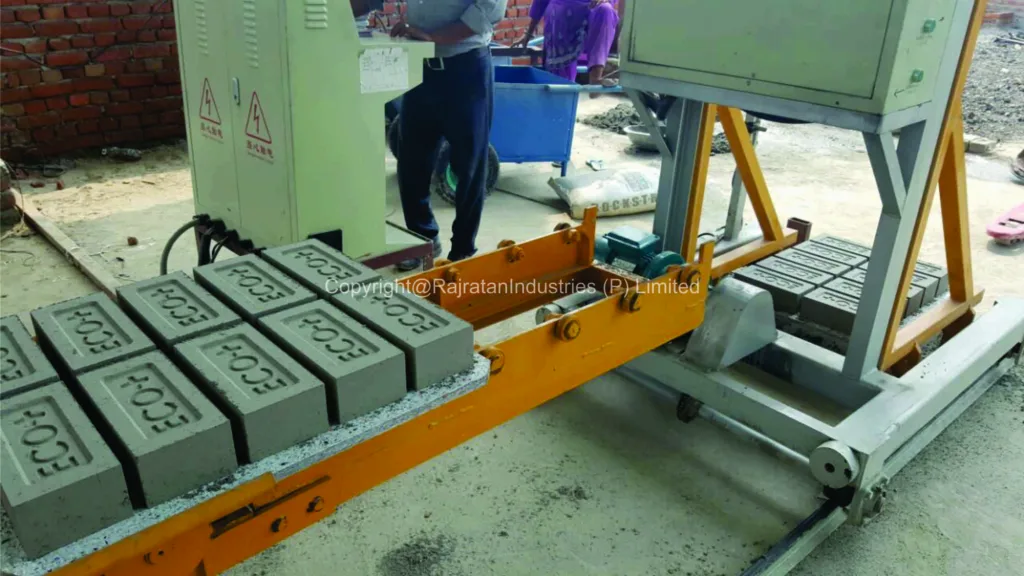
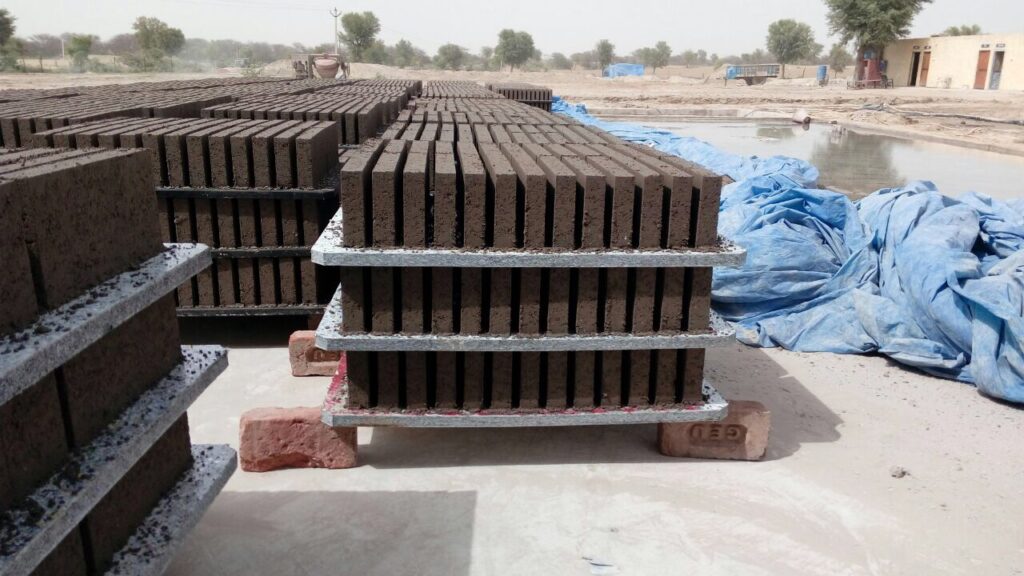
Theory meets practice in India’s brick and paver manufacturing sector. Rajratan pallets operate under 10–15 vibro-compaction cycles per hour—a relentless hammering that shatters timber pallets in weeks. Our metal-reinforced heavy-duty variants deliver 60+ cycles and 3–8 year service life while maintaining zero delamination and zero dimensional change.
Case Study—Flyash Brick Plant (Indore Region): Plant operator replaced timber pallets (failing after 8–10 uses) with PAC heavy-duty metal-reinforced pallets (₹4,200/unit). Over 36 months: 150 flyash brick cycles per pallet, zero replacements due to cracking, 40% scrap buyback credit (₹1,680/pallet) reinvested in new stock. Net cost: ₹2,520/pallet amortized over 3 years vs. ₹45,000+ in timber replacements.
Direct Answer: PAC pallets endure 40–100+ vibro-compaction repetitions in brick/paver plants without cracking, compared to timber pallets failing in 5–10 uses. Durability + 40% buyback credit justifies premium pricing while eliminating replacement waste.
—
Premium Positioning: Why PAC Pallets Command 40–50% Price Premium
At ₹4,200–₹5,400 per pallet (steel-reinforced heavy-duty), Rajratan’s pricing towers above cheap plastic alternatives (₹1,500–₹2,000) and timber (₹2,500–₹3,500). The premium reflects engineered durability: zero water absorption, certified load capacity, and 40% buyback value. Bulk buyers recoup investment through elimination of secondary failures, production downtime, and waste disposal costs.
TCO Comparison (36-month service life):
| Pallet Type | Initial Cost | Avg. Lifespan (Uses) | Replacements (36mo) | Total 3-Year Cost | Cost Per Use |
|---|---|---|---|---|---|
| Timber (Softwood) | ₹3,000 | 8–10 uses | 12–15 | ₹45,000 | ₹450/use |
| Low-Grade Plastic | ₹2,000 | 20–25 uses | 6–8 | ₹18,000 | ₹72/use |
| PAC Heavy-Duty (with 40% buyback) | ₹5,400 | 60+ uses | 0–1 | ₹5,400 (−₹2,160 scrap credit) | ₹53/use |
—
Buyback & Circular Economics: 40% Scrap Value Credit
After 60+ cycles, worn PAC pallets retain 40% of original material value. Rajratan accepts returned pallets and applies ₹2,160 scrap credit (on a ₹5,400 pallet) toward new inventory. This closes the circular loop: old pallets → recycled into fresh feedstock, reducing buyer’s total cost of ownership while ensuring zero landfill waste.
Example: Plant buys 20 pallets (₹108,000). After 3 years, returns 18 worn units. Scrap credit = ₹38,880. Net fresh pallet cost = ₹69,120 for three full years of operation.
Conclusion
Heavy-duty pallet performance is not determined by material strength alone. For high-volume brick, block and paver manufacturing, the combination of material quality, precision manufacturing, reinforcement and repeated-load performance plays a critical role.
Rajratan PAC® Heavy-Duty Pallets are positioned as an engineered solution for demanding production environments, combining industrial-grade plastic composite construction with steel reinforcement, controlled manufacturing and certified testing. The source highlights key benchmarks including 22.0 N/mm² compressive strength, 1135 kg/m³ density and up to 7500 kg static load capacity, along with resistance to moisture and repeated production cycles.
The long-term value also extends beyond durability. With a stated 40% buyback credit, PAC® pallets support a circular approach while helping manufacturers reduce replacement frequency, production interruptions and overall pallet-related costs.
For manufacturers where every production cycle matters, a heavy-duty pallet is not simply a platform—it is an investment in durability, consistency and long-term operating value.