
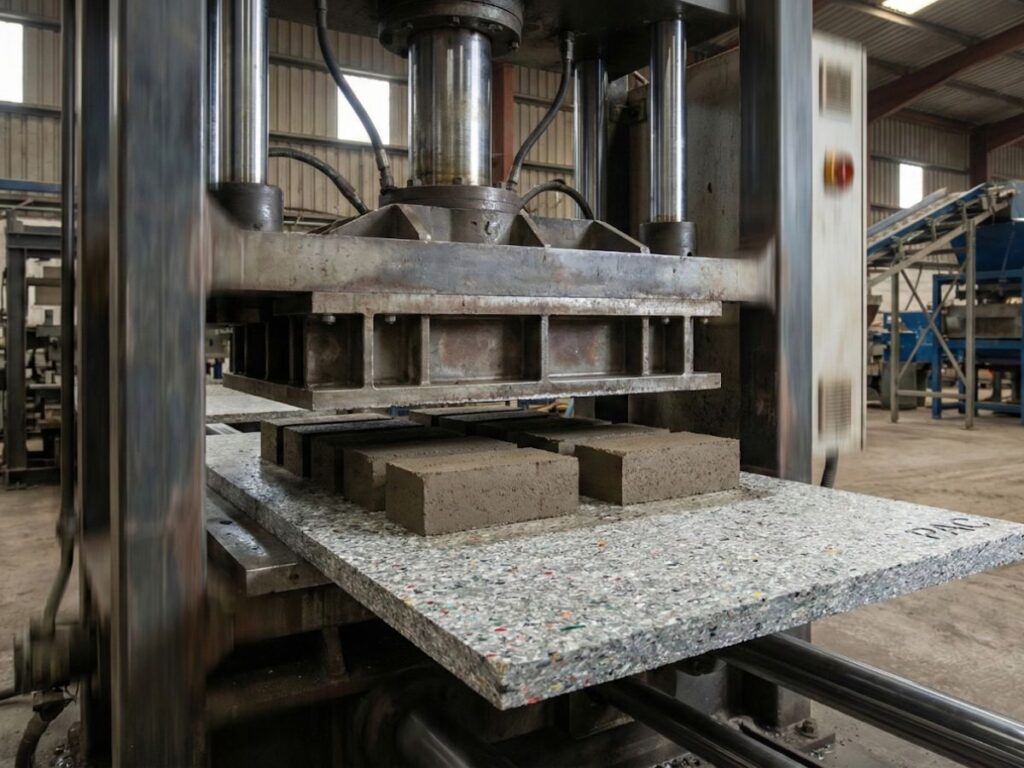
In brick and block manufacturing, vibration is often treated as a machine setting: adjust the frequency, increase the time, and move on. But vibration is not just a parameter it is a process force that directly shapes density, strength, surface finish, and long-term durability of the final product.
What’s less discussed is how vibration is transmitted, distributed, and absorbed. And that’s where the pallet plays a critical role.
Why Vibration is Central to Brick Quality
Vibration compacts the concrete or fly ash mix by:
- Removing entrapped air
- Allowing particles to rearrange into a denser structure
- Improving bonding within the mix
When vibration is effective, bricks achieve:
- Uniform density
- Better edge definition
- Higher compressive strength
- Reduced internal voids
When it isn’t, quality issues appear—even if the mix and machine are correct.
Uneven Vibration: A Common but Overlooked Problem
In real production environments, vibration losses occur due to multiple interfaces—one of the most important being the pallet beneath the brick.
If vibration does not pass uniformly through the pallet, compaction becomes uneven. This can result in:
- Soft corners and weak edges
- Density variation within the same brick
- Inconsistent strength results
- Higher breakage during handling
These issues often surface later, during curing or dispatch, making the root cause difficult to identify.
How Pallet Properties Affect Vibration
1. Flatness and Rigidity
A pallet that bends, even slightly, absorbs vibration instead of transmitting it. Over time, this creates uneven compaction zones and dimensional inconsistency.
2. Material Density
Very light or uneven-density pallets reduce vibration efficiency. A stable, uniform-density pallet allows vibration to spread evenly across the entire brick.
3. Long-Term Stability
As pallets age, many materials lose stiffness due to heat, moisture, and repeated vibration cycles. This gradual degradation changes vibration behaviour without operators noticing immediately.
Why PAC® Pallets Are Designed for Vibration Stability
PAC® Pallets are engineered specifically to address these vibration-related challenges.
Unlike cheap recycled plastic or wooden pallets, PAC® pallets are manufactured using industrial-grade pre-consumer plastics, combined with Aluminium Oxide, fibres, and XLP metals. This controlled composition ensures:
- Uniform density across the pallet
- High stiffness without brittleness
- Long-term dimensional stability under vibration
Each PAC® pallet is individually moulded and calibrated, not cut from sheets. This precision ensures consistent thickness and flatness—both critical for even vibration transfer.
Real Impact on Brick Quality
Plants using stable, vibration-efficient pallets typically observe:
- More uniform brick density
- Improved edge strength
- Reduced cracking during handling
- Lower rejection rates over time
PAC® pallets are designed to maintain these properties for years, not months, even under continuous vibration, heat, and moisture exposure.
Why Choosing the Right Pallet Is a Quality Decision
Adjusting vibration settings can only compensate so much. If the pallet beneath the brick is unstable, no amount of machine tuning can fully correct the problem.
Choosing a pallet is therefore not just a cost decision—it is a quality-control decision.
PAC® pallets support vibration rather than disrupting it, allowing machines to perform as intended and bricks to reach their full strength potential.
Conclusion
Vibration shapes brick quality—but the pallet determines how vibration behaves.
By ensuring flatness, rigidity, and consistent vibration transfer, PAC® pallets help manufacturers achieve stable compaction, predictable quality, and lower long-term losses. In modern brick and block production, investing in the right pallet is not optional—it is essential for controlling quality at the foundation level.