
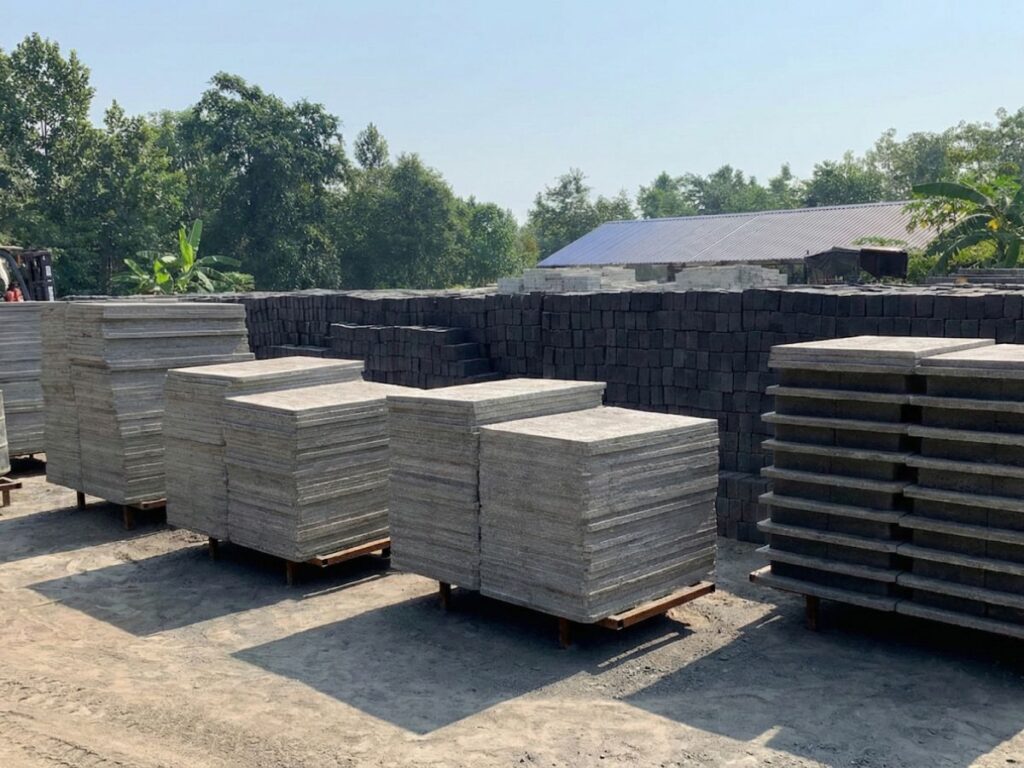
In India’s brick, block, and paver manufacturing sector, pallets are rarely discussed in boardrooms. They are bought quickly, used hard, and replaced quietly. Yet, across hundreds of plants, the difference between a pallet that lasts three years and one that performs for ten years or more is shaping productivity, quality consistency, and long-term operating cost.
This is not simply a question of price.
It is a question of performance under Indian conditions.
The Reality of Low-Cost Pallets in Indian Plants
Most low-cost pallets used across India are made from cheap recycled municipal plastic or wood-based composites. At first glance, they appear functional. They fit the machine, hold the product, and keep production running.
But performance over time tells a different story.
Within the first year, these pallets begin to show subtle signs of fatigue:
- slight surface waviness
- edge chipping from labour handling
- reduced vibration transfer
- early-stage bending that is often ignored
By the second or third year, these issues become structural. Pallets deform under vibration, crack at stress points, or lose dimensional accuracy. In brick and paver plants, this directly translates into:
- inconsistent brick height
- edge damage in pavers
- stacking instability
- increased rejection rates
While the pallet may not visibly “break,” its performance degrades long before it is replaced.
Why 3-Year Pallets Fail Early ?
The primary limitation of low-cost pallets is material inconsistency.
Municipal recycled plastic contains:
- mixed polymer grades
- paper, dust, and filler contamination
- uneven density across the board
Under constant vibration, moisture exposure, and heat — all common in Indian plants — these impurities weaken internal bonding. Over time, the pallet loses rigidity, leading to bending and cracking.
Most importantly, these pallets are typically cut from sheets, not moulded individually. This results in:
- uneven thickness
- poor vibration transfer
- faster edge wear
The outcome is predictable: frequent replacement, higher downtime, and hidden production losses.
The 10-Year PAC® Industrial Pallet Approach
PAC® Industrial Pallets are engineered for an entirely different purpose: long-term dimensional stability.
Instead of municipal waste plastic, PAC® pallets are manufactured using industrial-grade pre-consumer plastics, combined with Aluminium Oxide, fibres, and XLP metals. This controlled formulation ensures uniform density, mechanical strength, and predictable performance over thousands of production cycles.
Equally important is the manufacturing process.
Each PAC® pallet is individually moulded and calibrated, rather than cut from bulk sheets. This guarantees:
- perfect flatness
- uniform thickness
- consistent vibration transfer
- better compaction and product uniformity
These design choices are the reason PAC® pallets commonly deliver 8–10+ years of active service life in Indian brick, block, and paver plants.
Performance Differences on the Factory Floor
1. Dimensional Stability
Low-cost pallets gradually lose flatness, leading to uneven products. PAC® pallets maintain shape even after years of vibration and load cycles, ensuring consistent brick and paver dimensions.
2. Vibration Transfer
In vibro and hydro-vibro machines, pallet density and stiffness directly affect compaction. PAC® pallets distribute vibration evenly, improving strength and surface finish.
3. Resistance to Indian Climate
Low-cost pallets absorb moisture and soften under heat. PAC® pallets are waterproof, UV-resistant, and unaffected by monsoon or summer conditions.
4. Service Life
Typical low-cost pallets last 2–3 years. PAC® industrial pallets routinely exceed 10 years, depending on reinforcement and application.
The Cost Perspective: Why Upfront Price Is Misleading
When viewed purely as a purchase, low-cost pallets seem economical. But when assessed over production cycles, the numbers reverse.
A plant using 3-year pallets may replace the same pallet three to four times over a decade. Each replacement involves:
- pallet purchase
- machine downtime
- labour handling
- rejected products during transition
PAC® pallets, on the other hand, reduce replacement frequency dramatically. When combined with a 40% buyback replacement programme, end-of-life pallets retain residual value rather than becoming waste.
The result is a lower cost per cycle, not just a higher lifespan.
Why This Matters for Indian Brick, Block & Paver Plants
India’s manufacturing environment is unforgiving:
- open yards
- high humidity
- long operating hours
- labour-intensive handling
Pallets designed for short-term use struggle to survive these conditions. Plants that rely on them often compensate by accepting higher rejection rates and frequent replacements.
Long-life industrial pallets shift this equation. They stabilise production, protect machine performance, and reduce variability across batches -a critical advantage as Indian plants scale up to meet infrastructure demand.
Conclusion
The difference between a 3-year pallet and a 10-year pallet is not just durability — it is production reliability.
Low-cost pallets fail quietly, eroding quality and efficiency over time. PAC® Industrial Pallets are built to perform consistently under Indian factory conditions, delivering stability across brick, block, and paver production for nearly a decade.
Know more about PAC® Pallet – Rajratan PAC® Pallet
- Phone: 0731 4045302
- Mobile: +91 96857 27927
- Email: info@rajratan.in