
Choosing the right pallet reinforcement is not guesswork — it’s engineering.
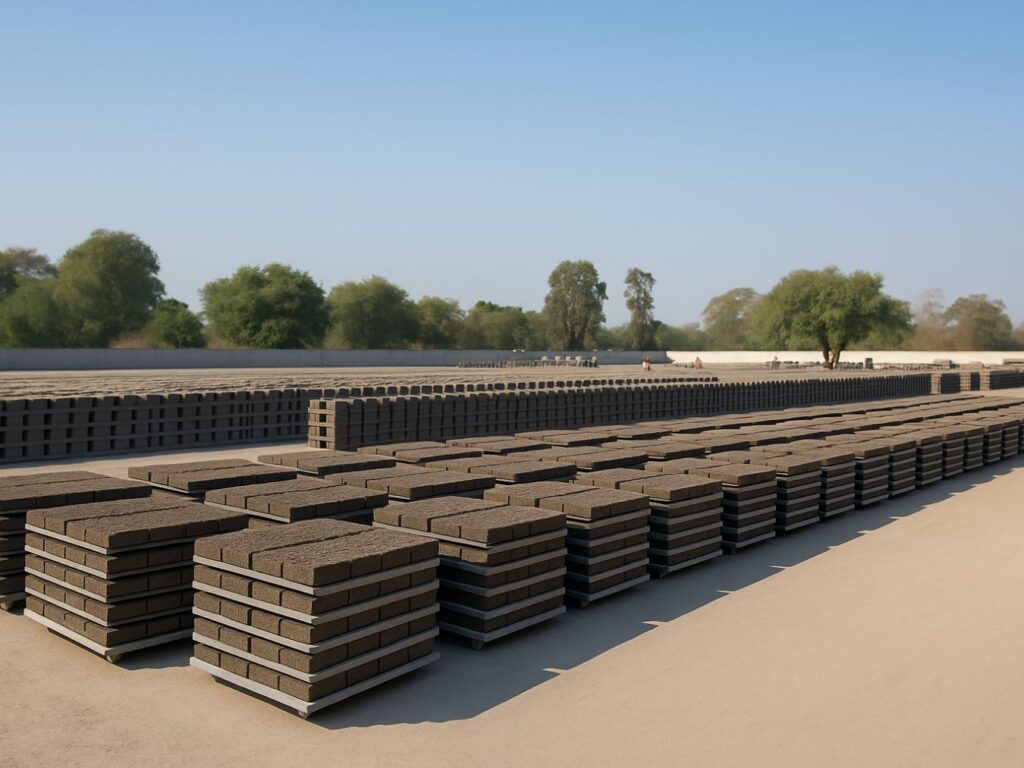
In the brick, block, and paver industry, a pallet is not “just a pallet.”
It is the foundation on which every brick is shaped, compacted, cured, and transported. One weak pallet in the cycle can distort dimensions, cause cracking, disrupt machine rhythm, and increase rejection rates.
That’s why pallet reinforcement matters. The right reinforcement boosts consistency, reduces downtime, and ensures every cycle delivers uniform products.
But with multiple options—Fibre Reinforced, Metal Reinforced, and Steel Reinforced—how do you know which one your plant truly needs?
Let’s break it down clearly.
Why Reinforcement Exists in the First Place?
Reinforcement is added to a composite pallet to solve three real-world problems seen in factories:
1. Bending under machine vibration
Cheap recycled plastic or wooden pallets warp due to uneven vibration transfer.
2. Cracking due to weight load
Wet bricks, hollow blocks, and solid blocks exert intense point pressure.
3. Loss of accuracy over time
Even slight deformation leads to dimensional errors and high rejection rates.
Rajratan’s PAC® Pallets solve these issues using different reinforcement grades engineered for different machine intensities and product categories
1. Fibre Reinforced Pallets — Lightweight Strength for Standard Production
Fibre reinforcement is designed for small to mid-sized units where the production load is moderate but consistency still matters.
How it’s engineered
This board uses a composite of:
- industrial-grade plastics (PP, LDPE, HDPE)
- Aluminium Oxide
- high-strength cotton fibres
The fibres distribute load across the board, preventing sudden cracking or edge chipping. They also reduce weight, making handling easier for labour-intensive units.
Where it works best
- fly ash bricks
- paver blocks
- parking tiles
- top-press hydro machines
- vibrating table systems
When to choose it
Choose fibre reinforcement if your plant prioritizes cost-efficiency, moderate production speed, and easier pallet handling, and if you don’t produce very heavy products like solid blocks.
2. Metal Reinforced Pallets – Balanced, High-Performance Reinforcement
Metal reinforcement is the most widely used reinforcement type in India because it offers the best balance of strength vs. cost.
What makes it different
Along with industrial-grade plastics and Aluminium Oxide, these boards include XLP metal strips blended within the composite. These metals increase stiffness and prevent flexing during vibration cycles.
Why it’s the industry favourite
Unlike fibre reinforcement, metal reinforcement can handle higher frequency vibration from:
- imported vibro machines
- hydro vibro systems
- mixed SKU production (bricks + pavers + hollow blocks)
Metal reinforcement ensures that the pallet transfers vibration uniformly, which directly affects compaction density and final block strength.
When to choose it
You should choose metal reinforcement if your plant:
- runs 8–12 hours a day
- uses vibro machines
- produces a mix of products
- often struggles with dimensional inconsistencies
It’s the “mid-range” reinforcement, but in reality, it’s the workhorse for most Indian plants.
3. Steel Reinforced Pallets – Built for Extreme Loads and Long Hours
Steel reinforced pallets are the top-tier option, designed specifically for high-intensity production and heavy products.
Inside the structure
These boards contain:
- industrial-grade plastics
- Aluminium Oxide
- XLP metals
- a 12mm diameter steel tube frame (2.5–3mm thick walls) integrated into the pallet
This steel frame prevents ANY deformation even under the heaviest load.
Who needs steel reinforcement?
Plants that:
- produce solid blocks, RE blocks, and other heavy units
- run heavy-duty multi-product vibro machines
- operate 12–20 hours a day
- require a pallet that lasts 7–10+ years
In these environments, fibre and metal reinforcement simply cannot prevent bending — but steel reinforcement can.
When to choose it
Choose steel if your production involves:
- solid blocks
- high compaction pressures
- long operating hours
- multi-product lines in a single machine
It is the ultimate reinforcement for serious manufacturers.
How to Choose the Right Reinforcement: A Practical Guide
Here’s a simple rule:
Choose Fibre Reinforcement if
Your output is light–medium, and you use hydro or vibrating table machines.
Choose Metal Reinforcement if
You run vibro machines or produce multiple SKUs.
Choose Steel Reinforcement if
You produce solid blocks or run high-intensity production for long hours.
Conclusion
The right pallet reinforcement is what ultimately decides your production stability and long-term cost. Fibre, metal, and steel reinforcements each have a purpose — but only engineered composite pallets built with industrial-grade materials deliver consistent performance on Indian factory floors. That’s why Rajratan’s PAC® Pallets remain a preferred choice for manufacturers who want durability, precision, and a lifespan that actually justifies the investment.
Know more about PAC® Pallet – Rajratan PAC® Pallet
- Phone: 0731 4045302
- Mobile: +91 96857 27927
- Email: info@rajratan.in